Far from the Reed Bed
Only death is silent, and listening is a way of understanding how we live.
Sound does not stay where it begins. It leaves one body and enters another, crosses walls and borders, and outlives the voice that made it. Every act of listening is a relation, with others, with the world, with oneself. A city keeps its sounds the way a family keeps its stories. It holds what people build and lose, the music they may play and the music they must hide, the homes they carry when they leave. We grow up inside these sounds. They tune the ear, then the self, and shape where we feel we belong.
I grew up in a city where music was never simply allowed, and that taught me early that sound is never neutral. It carries memory and power. It reveals what the eye passes over.
My work begins there. I listen to cities and the traces migration leaves in them, to objects that sound only when touched, to the silence around a solitary listener, and to a voice still waiting for an answer. Through composition, improvisation, audiovisual performance, and installation, I ask one question. How does listening shape who we are, how we relate to others and to places, and where we feel we belong?
How I work
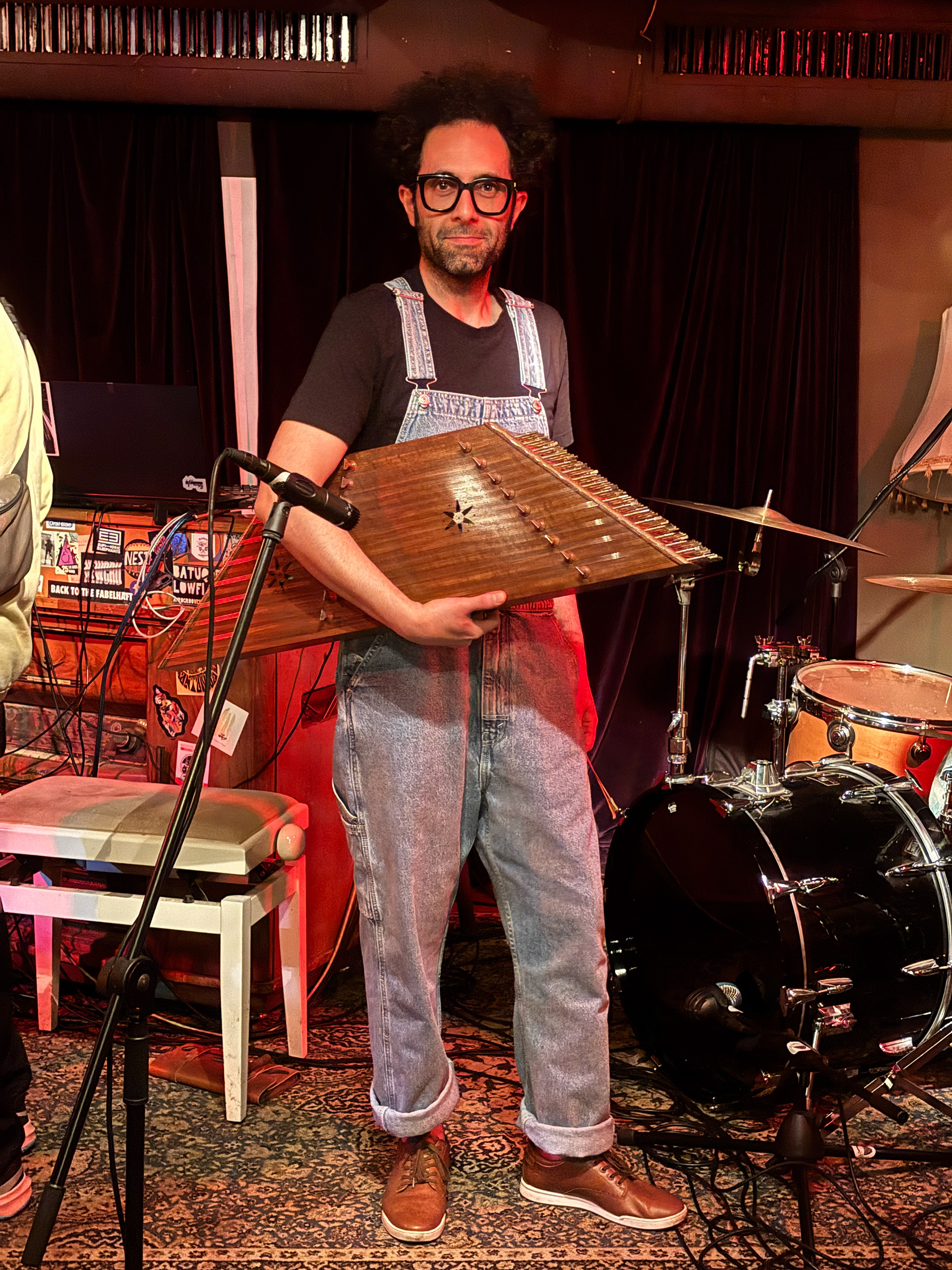
Everything I make begins with listening to the present moment. My path has run from the radif of Mirza Abdollah, the foundation of Persian classical music, through John Cage's thinking, which opened music to every sound, toward a practice of my own. Persian classical music gave me my first lessons in listening. Its improvisation is a conversation. One musician offers a phrase, another takes it up, and answers, and the music lives only in that exchange, never quite the same twice. I learned this on the santur, and the same attentiveness now shapes everything I do, whether I compose, work with electronics or play with others.
The santur is a migrant instrument. Its ancestors appear in the art of ancient Mesopotamia, and its relatives travelled by land and sea to India, China and Europe, changing shape wherever they settled. Now it has travelled with me, and my work asks how it can keep its roots while finding a new voice.
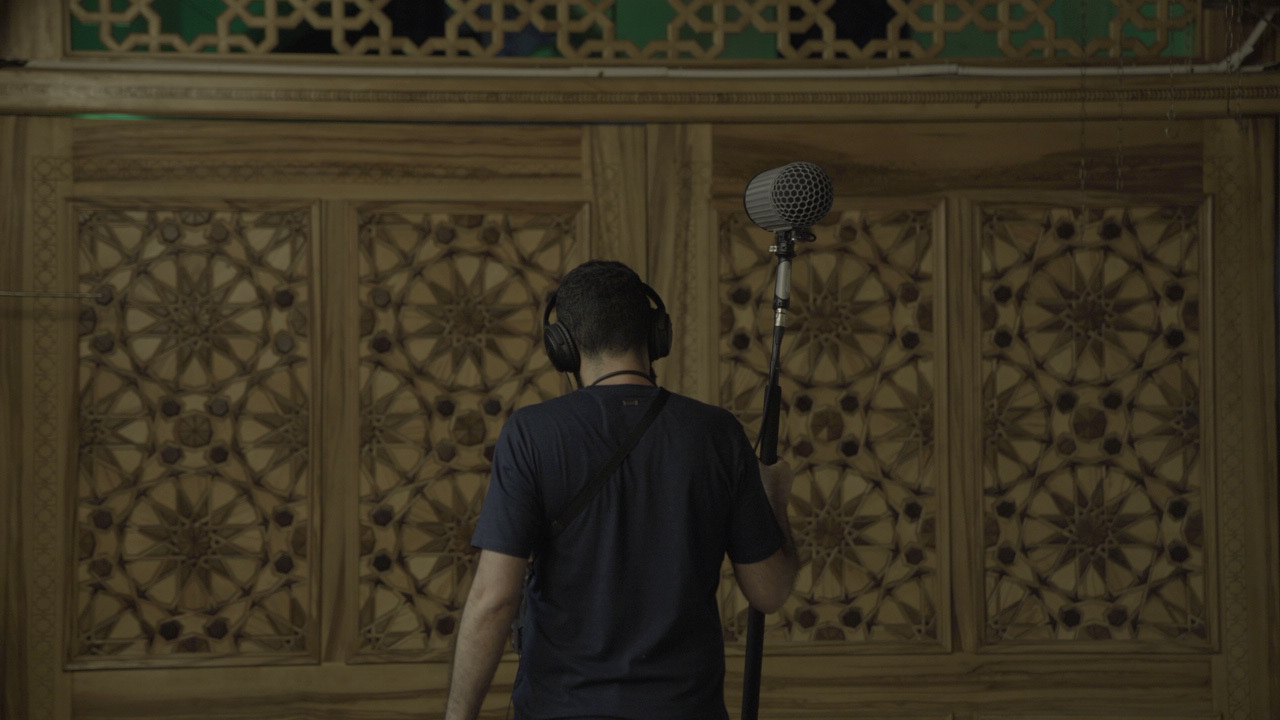
Beyond the instrument, I listen to everyday life. Ordinary actions, gestures and materials give me rhythm and texture, and teach me to hear timbre beyond pitch and rhythm beyond metre. I compose with field recordings and build sounding objects and kinetic sculptures from motors, pipes, plastic and mirrors. In audiovisual work, sound and image are made together.
In my installations, how visitors move and how long they stay shape what they hear, and in some works the sound falls silent as they approach. Behind this work stand literature, philosophy and Islamic mysticism, above all Ibn Arabi and other Islamic thinkers who wrote about solitude, passage and the self. I talk about how this approach developed in my autobiographical videos.
Beginnings in Mashhad
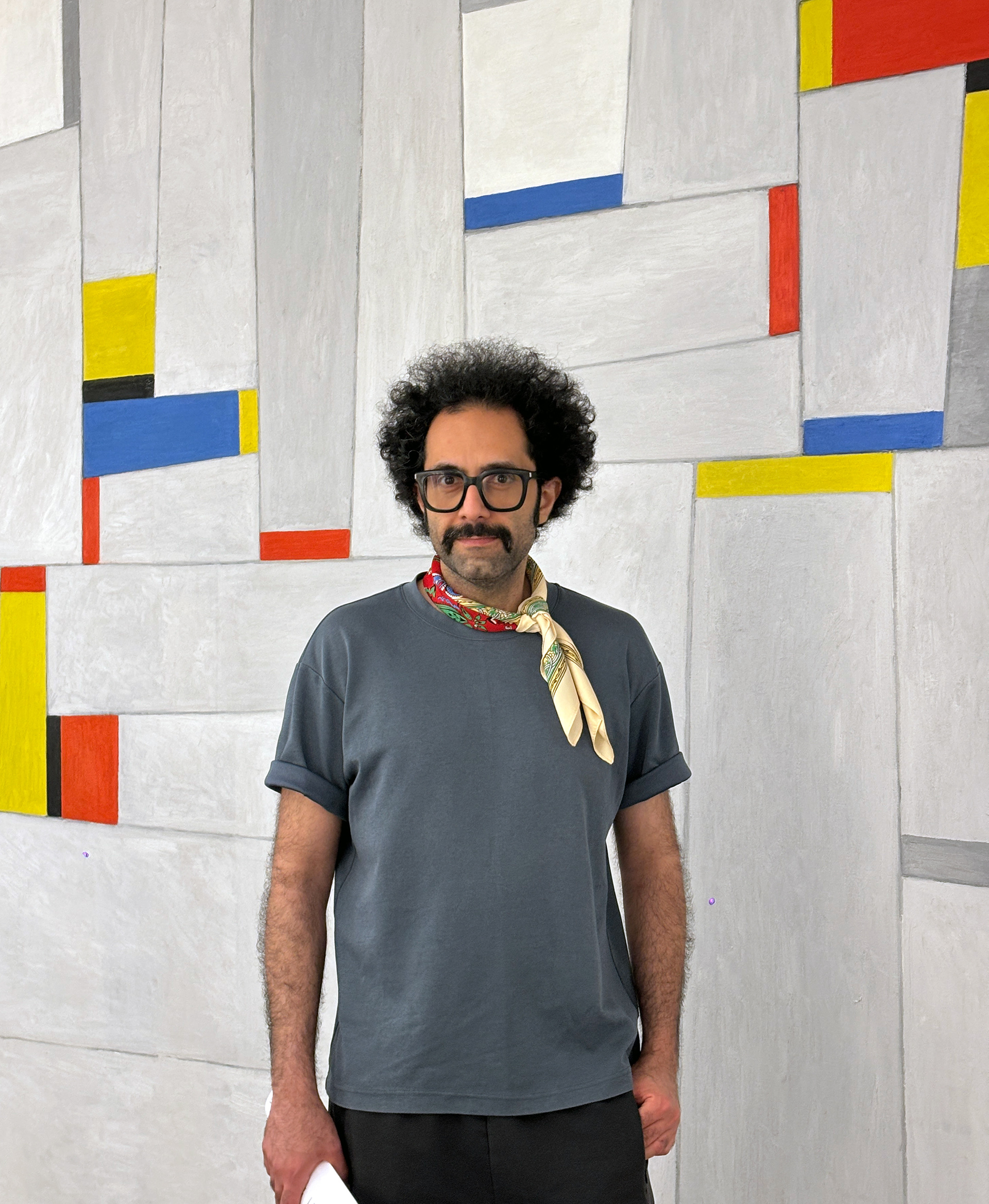
I was born in Mashhad in September 1984 and began playing the santur at the age of six. Once, at a family celebration, I played dance music and was sent away from my lessons for it. It was my first lesson in how politics and religion can decide which music is allowed. I kept playing. I studied for many years with the late master Khamr, then with Toufan Teymouri and Mohammad Reza Haghgoo. As a boy I appeared as a soloist in a concert of Khamr's students at Ferdowsi University, and as a teenager I played with the Delshodegan ensemble at Andisheh Hall and in the Nima Grand Orchestra conducted by Haghgoo. You can hear my playing on my santur page.
Tehran
In 2003, after a semester of study with Houshang Kamkar, I entered the Faculty of Fine Arts at the University of Tehran. There I completed a BA in Iranian music performance on the santur in 2009 and learned the radif with Majid Kiani. I studied Iranian music with Hooman Asadi, Dariush Talai, Khosrow Molana, Mohammad Reza Darvishi, Darvish Reza Monazzami and Sasan Fatemi, and Western theory and composition with Shahin Farhat and Alireza Mashayekhi. I played santur in Mashayekhi's New Music Orchestra, including at the Fajr Music Festival at Rudaki Hall. From 2008 to 2012, I taught santur at the university, and I continued my own santur studies with Ardavan Kamkar. That's how I remember Tehran is my video about those years.
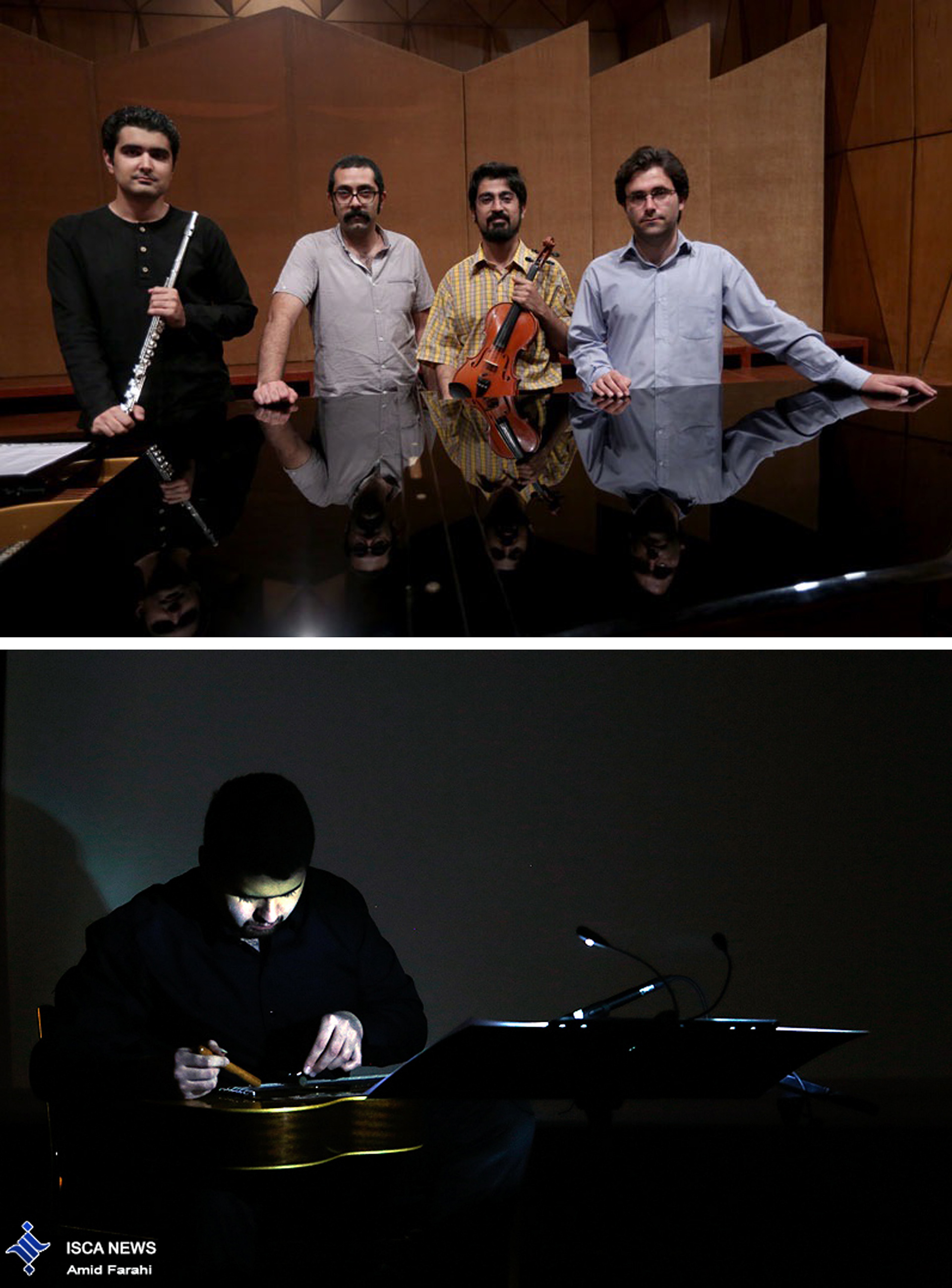
An MA in composition followed, from 2012 to 2015, and with Amin Honarmand and Kiavash Sahebnasagh I discovered electronic and contemporary music. The Tehran Music Group, founded by Farimah Ghavam Sadri and Alireza Mashayekhi, performed my first contemporary piece, Absurd No. 1, a trio for violin, flute and piano, at Rudaki Hall. In 2014, ISNA and Borna News quoted the note I wrote on the group's history, and the press followed its Classical to Contemporary Music Festival. My first multimedia work, From… To…, for guitar and live painting by Babak Etminani, premiered at Rudaki Hall, and a year later I was invited to perform it at a festival in Milan.
I also spent a year in Rouin Pakbaz's course on the history of art at Atelier Shen, a long walk through painting, sculpture and architecture from the first cave paintings to the art of today. It still shapes how I see.
Writing ran alongside the music. In 2013 I interviewed Mashayekhi for Etemad newspaper on Iranian music and European polyphony. I worked as a freelance journalist and recorded an oral history of Iranian music with Mohammad Reza Lotfi and other musicians.
From 2016 to 2018 I lectured on music history, theory and appreciation at Islamic Azad University North Tehran and the University of Applied Science and Technology. In 2016 I founded Aknoon Music School, an affordable path into serious music study, and directed it until 2019. Its workshops ranged from Saba's rhythmic pieces with Chakad Fesharaki and the radif with Babak Rahati to composing with a mobile phone and my own listening workshop. The school closed under increasing regulatory pressure.
Darmstadt
In 2014, I flew from Tehran to the Darmstadt Summer Courses for New Music. In the first days, I heard Stockhausen's Carré, written for four orchestras and four choirs. I had never heard live orchestral sound on that scale. In two weeks I heard more than in all the years before.
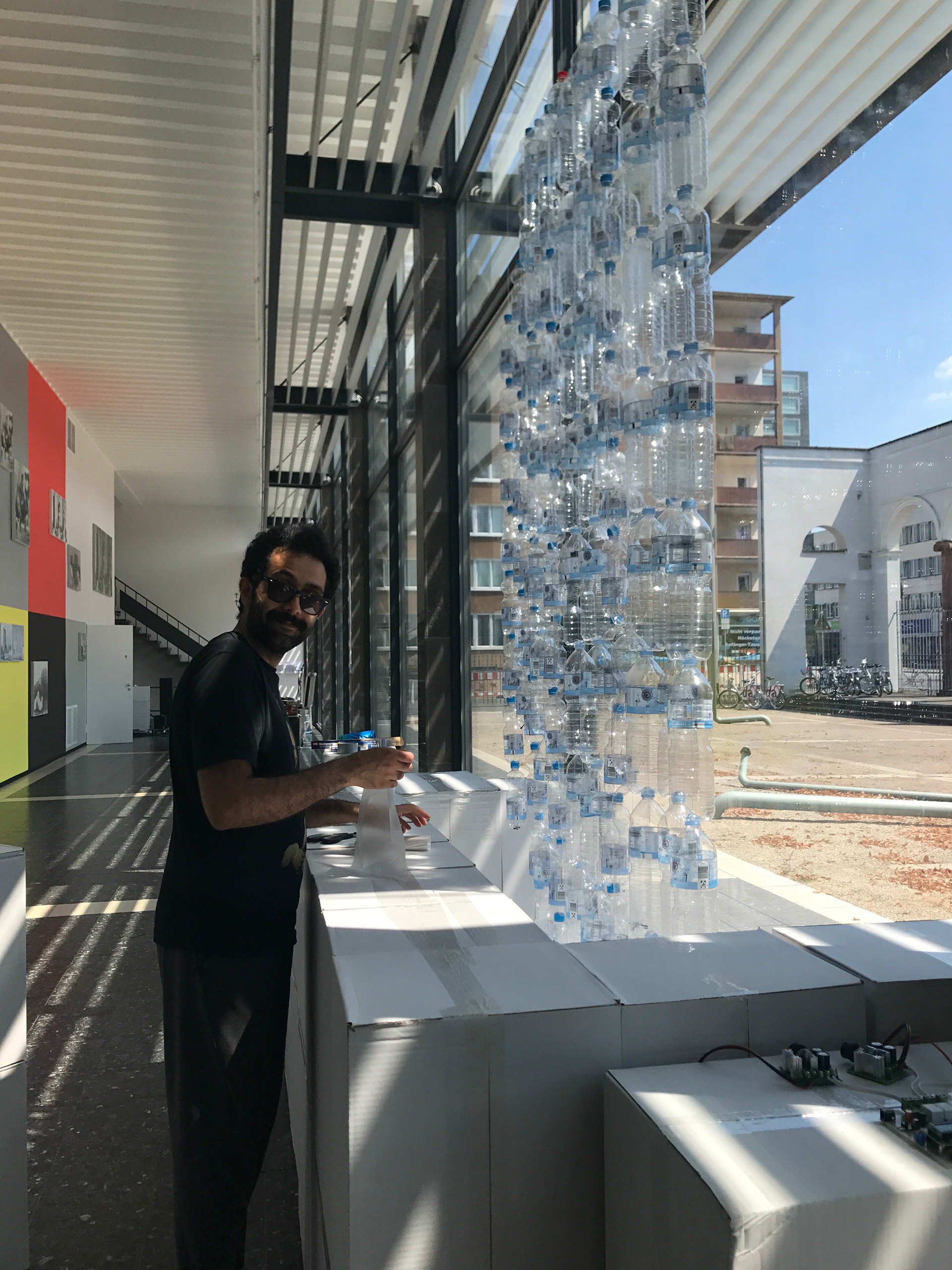
In 2018 I carried this new way of working back to Darmstadt. I presented my first sound installation there, Of such dying, made of motors and plastic, and joined Discontinuity, a selective workshop led by the composer Michael Maierhof. In 2023, Joevan de Mattos Caitano discussed the piece and my time at Darmstadt in his study of Darmstadt and the Middle East, published in MSGSÜ Sosyal Bilimler. He reads it as a hyperrealistic music made from the everyday sounds people pass by without a thought.
Sound art in Tehran
Back in Tehran, composing meant a long chase. Each new piece needed skilled performers of contemporary music, a hall and a permit, and every step was a negotiation. I grew tired of running after all of it just to hear one work performed. Meanwhile, the world around me was full of sound. Why should those sounds not make my music? That is how I came to sound art, before I even knew its name.
I began building works from objects and natural materials. Farmanfarma Gallery commissioned Continuity as its sound element in 2017 and showed my solo exhibition My Ear of Solitude in 2018. The sounds in my head could not be made by any instrument, I told Honar Online, so I turned to objects. Shargh newspaper titled its interview about the show An Invitation to Listen. I was a selected artist at the first International Environmental Art Festival in Chabahar, made a sound installation in Rasht and took part in the eleventh Fajr Visual Arts Festival. My film In Chabahar follows the work there, and I spoke about these years with ANA. In a conversation with Maryam Roshanfekr for AVAM Magazine, I said that music has no body, only an atmosphere, which makes it closer to architecture.
In January 2019, my solo video art exhibition Existence, curated by Pegah Behroozfar, opened at Solouk Art Gallery. One afternoon during the show, Marzieh Nezamabadi and I performed Existence, music for santur and the sound of painting. The performance was recorded, and Javid Ramezani reviewed it in AVAM.
A year later, as a finalist for the third Vista Contemporary Art Prize, I showed Shogh in The Third Line at Vista Art Gallery. Ninety-nine acoustic columns stood like a late Romantic orchestra and led visitors toward images transformed by the sound of decay, asking what it means to arrive without walking the path. I talked about the piece and the prize with Iran Art News. My one-minute work Crossing was screened at the Limited Access Festival in 2019.
Sensory Souvenir
When I moved to Germany, my subject moved with me. My own fear of and wonder at new sounds and smells became Sensory Souvenir, a project about how immigration changes the way European cities sound and smell. I asked migrants about the last sound they heard at home, the food they miss, the music they stopped or started playing. At the same time I studied new composition techniques in a Kontaktstudium at the Hamburg University of Music and Theatre with Alexander Schubert and Georg Hajdu.
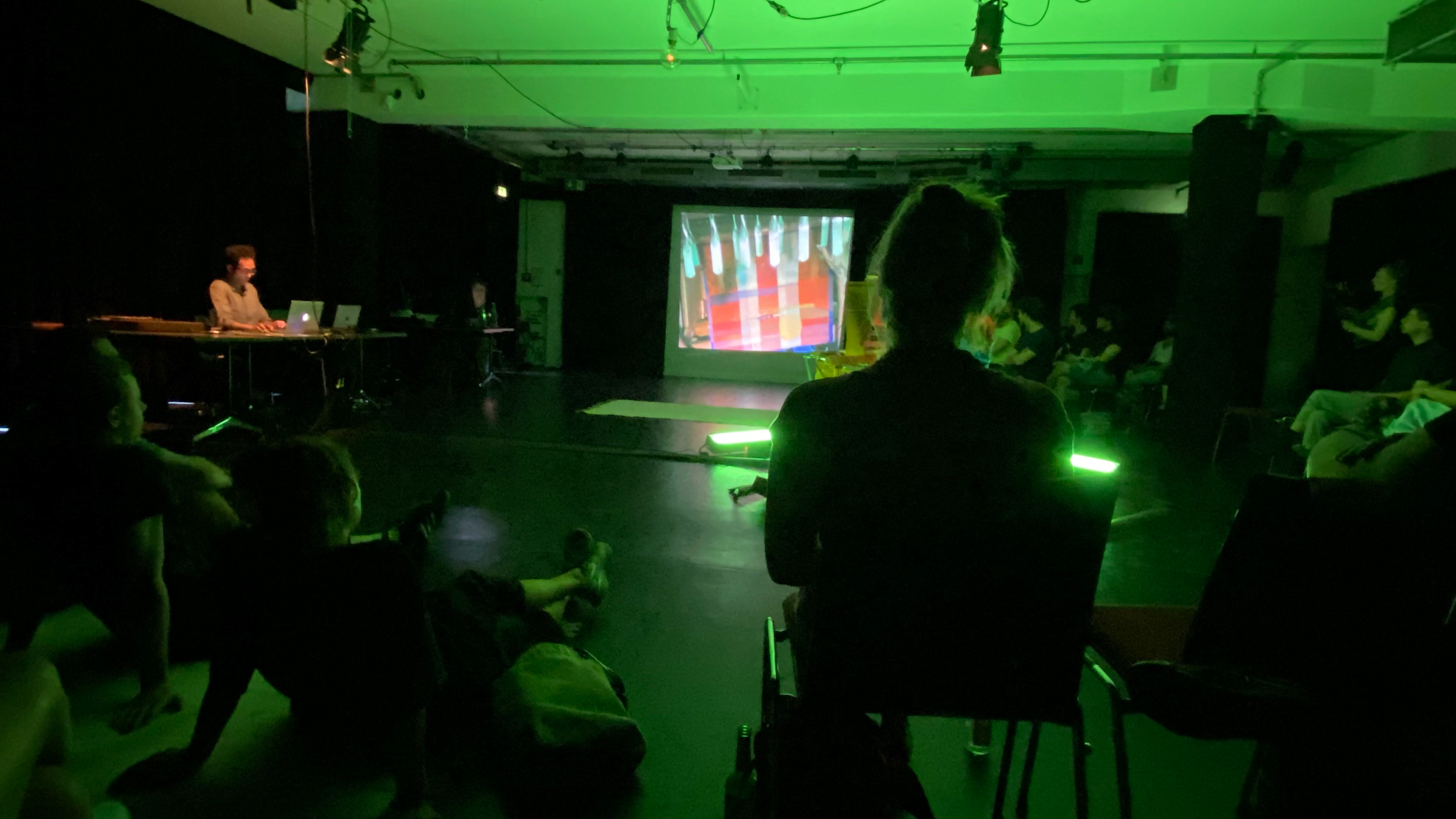
The project grew within the Forecast mentorship programme, where the artist Emeka Ogboh chose it for treating the city as a place of cross cultural encounter, and I joined Forecast's nominees. In September 2021 I premiered a documentary for it at the digital Forecast Forum, introduced by a short film. In March 2022 I worked with Ogboh in Rome on a work stay at MAXXI supported by Villa Massimo, interviewing members of immigrant communities and recording the food markets. The installation opened at Radialsystem in Berlin on 8 and 9 April 2022, where migrant performers moved among everyday objects between the familiar and the foreign, and I led a Euro Soundscapes workshop at the same festival. The interviews, my portrait Sonic observer, a project video and the Forecast catalogue record the work, and its own page on this site gathers all of it.
Braunschweig fellowship
In Braunschweig I turned from the city's present to its past. As one of seven international fellows of the Braunschweig Projects programme at HBK Braunschweig in 2023 and 2024, I began from one thought. We build cities to communicate, and then our cities build us. Under the working title From Jungle to Skyscraper I traced the human soundscape from the forest to the metropolis.
The result was Ecotopia, a twenty channel installation in which every visitor composes. Visitors chose what each of twenty speakers played, from birdsong to traffic, and their choices blended into one constantly changing soundscape, while images of nature, cities, history and politics moved across the wall. Drawing on Pascal Amphoux's model of sonic identity, it asks how our surroundings shape us and how we shape them. It was shown at the fellowship's final exhibition in the Montagehalle from 2 to 16 February 2024, alongside the work of the other fellows.
Research
These questions of listening, relation, and belonging also run through my research, where my practice meets my long interest in literature and philosophy. Acoustemology, the idea of sound as a way of knowing the world, gives me one way into them. My doctoral research at TU Berlin, supervised by Hans-Christian von Herrmann, asks how listening can create relation and also expose disconnection, how a solitary self listens when no answer comes. It is titled Sonic Forms of Loneliness, subtitled Listening, Auditory Relation, and Disconnection in Hedayat, Kafka, and Beckett.
I am also developing a comparative study of the santur as a percussion instrument, following how it adapted as it travelled among the hammered dulcimers of West Asia, India and Europe. In 2025, I took part in Time to Listen, a conference on listening in Berlin.
On stage and in collaboration
Collaboration carries the same listening onto the stage. For Loom, in the Klangteppich series at tak Berlin in June 2023, I worked with the weaver Kira de Picciotto, processing the sounds of her loom live alongside live video, recorded sound, composed music and santur, and the taz wrote about the evening. On 18 January 2026 Marzieh Nezamabadi and I returned to the duet for santur and painting sounds we first performed at Existence in Tehran, this time at Kühlspot Social Club in Berlin. Earlier that month I gave a concert at Richten25.
In Ons Trio, with Asal Karimi on kamancheh and Khayrollojon Dadoboev on percussion, I play the reng, the dance form of Persian classical music that religious, political and modernist pressures pushed to the margins. It is the same music I was once sent away from my lessons for playing. The trio set out to bring such forms back into living practice, and we opened the Welcome Music Session in Hamburg on 13 February 2025.
From the reng I turned east. The santur reached Kashmir centuries ago, and in India it is played in its own way. With the renowned Indian tabla player Herry Singh I developed Kashmir Voyage, a dialogue in which the Iranian radif and the Indian ragas listen to each other. Our work grew over several concerts, among them one at the Indian Consulate in Hamburg and one on 15 August 2025 at the International Summer Festival at Kampnagel.
On 27 November 2022 I improvised on the santur at In Focus Iran #1 Frau, Leben, Freiheit, an evening of solidarity with artistic protest in Iran. My video Improvisation in solidarity with Iranian protesters comes from the same moment.
I also work as a sound and video artist in other people's productions. I was sound artist for Ensemble Megaphon's Rolling Silence, a concert about the seas and the climate crisis, which travelled from Hannover to Bremerhaven. I was video artist, with Jacob Sello, for Greg Beller's opera The Fault, premiered at the Hamburg University of Music and Theatre in January 2023, and sound and video artist for Véronique Langlott's Pop-Up Folklorique at LICHTHOF Theater in 2022. As deputy chair of Stimme X, which supports contemporary music theatre in northern Germany, I help migrant artists find stages, and I worked on communications for the Stimme X Festival 2026 at LICHTHOF Theater.
Teaching and conversation
I began teaching as a teenager, in my last years in Mashhad, and I have taught ever since. Technique, repertoire and tradition matter in my lessons, but they serve a larger aim, which is to help each student become the musician they want to be. We listen closely, practise seriously and learn the tradition well, so that students can make their own choices instead of repeating someone else's. That is why improvisation sits at the centre of my teaching.
The santur does not belong only to those who speak Persian. It is a migrant instrument, and I teach it with its full classical grounding as a way of meeting other musicians, from China to Europe, on the student's own terms.
Since October 2024, I have run free online seminars for young artists in Iran on residencies, portfolios and applications to programmes in Europe. In 2021 I spoke alongside Tullis Rennie at the Sonic Tehran network. I have discussed my work on Deutschlandfunk Kultur's Tonart, and in 2022 Gaby D'Annunzio interviewed me for Agora, a podcast series also on YouTube.
More of my work is on Darz, Gallery Info and IRCAM's ULYSSES platform, and the latest is on Instagram, SoundCloud and my news page.
Work with me
I welcome invitations to perform and improvise as a santur player and electronic musician, in acoustic performances or with live electronics, and collaborations with visual art and movement. I take commissions as a composer, sound artist, and video artist, in composition, sound design, audiovisual work, and installation. I teach santur, improvisation, electroacoustic composition, field recording, and installation in English and Persian, one-to-one or in workshops. My SoundBetter profile lists production services such as immersive mixing and podcast editing. If you have something in mind, get in touch.